
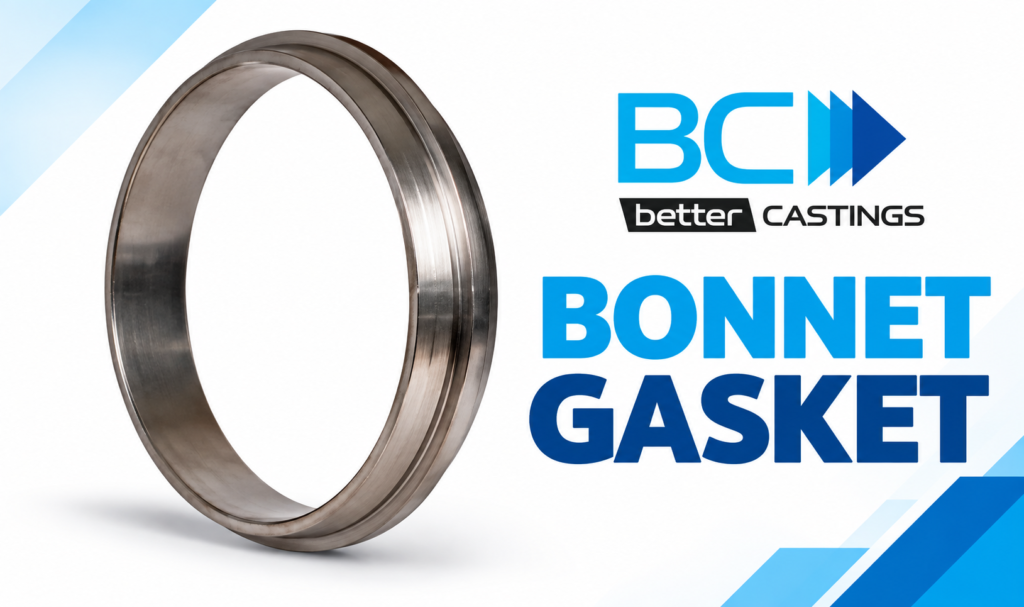
WHAT IS A BONNET GASKET?
A bonnet gasket is the seal between a valve’s body and its bonnet. It closes the leak path at the body-to-bonnet joint, which is part of the valve’s pressure boundary.
The body holds the flow path, seats and trim. The bonnet houses the stem, the packing and the actuator. The gasket is compressed between the two during assembly. In pressure-seal designs, system pressure adds to that compression.
In service, the gasket faces pressure, temperature swings and process fluid. The wrong gasket can degrade, swell and leak.
WHY DOES THE BODY-TO-BONNET JOINT NEED SEALING?
The body-to-bonnet joint is a primary pressure boundary. A leak here sends process media straight to the atmosphere and bypasses the valve seat.
- Safety risk: Hydrocarbons can cause fire or explosion, sour gas (H₂S) is toxic, and steam causes severe burns.
- Regulatory risk: The leak may be reportable, which triggers unplanned LDAR (Leak Detection and Repair) work and compliance follow-up.
- Reliability risk: The valve must be isolated and depressurized. Downtime can cost far more than the valve itself.
The gasket is cheap, but a failed one is not.
WHAT ARE THE MAIN TYPES OF VALVE BONNETS?
- Bolted bonnet: Bolts compress the gasket between flanges. Gives full trim access and is used across most industrial pressure classes.
- Pressure-seal bonnet: System pressure pushes a seal ring into a tapered body bore, so the seal tightens as pressure rises. Standard for high-pressure and steam valves.
- Screwed / union bonnet: Threads onto the body. Suits small, low-pressure valves that need frequent trim access.
- Welded bonnet: Welded to the body, with no gasket. For minimal leakage where internal access is rarely needed.
WHAT ARE THE TYPES OF BONNET GASKETS?
| GASKET TYPE | PRESSURE RANGE | BEST APPLICATION | REUSABLE? |
|---|---|---|---|
| Ring Joint (R / RX / BX) | High | Wellhead and pipeline valves | No |
| Spiral Wound | Wide range | Refinery and chemical process valves | No |
| Flat Soft | Low to moderate | General-service bolted bonnets | No |
| Graphite Pressure Seal | High | High-pressure steam and hydrocarbon service | No |
| Elastomeric (FKM) | Specialized | Selected check valves and services | No |
WHICH MATERIALS ARE USED FOR BONNET GASKETS?
| MATERIAL | MAX. TEMP.* | CORROSION RESISTANCE | PRIMARY USE |
|---|---|---|---|
| Soft Iron | ~400 °C | Low | Low-pressure RTJ |
| Carbon Steel | ~450 °C | Low–Medium | Selected RTJ |
| Stainless Steel 316 | ~550 °C | High | RTJ and spiral wound |
| Flexible Graphite | ~540 °C | Excellent | Pressure-seal rings |
| PTFE / Filled PTFE | ~260 °C | Excellent | Soft gaskets, aggressive chemicals |
| FKM (Viton) | ~200 °C | Good | Elastomeric seals |
Typical values. Actual limits depend on service and manufacturer rating.
SS 316 is the most common choice in oil and gas, but confirms it for sour service. PTFE is not suitable for high-temperature steam.
HOW DO YOU SELECT THE RIGHT BONNET GASKET?
| VALVE CLASS | TYPICAL GASKET | TYPICAL MATERIALS |
|---|---|---|
| 150–300 | Flat soft or spiral wound | PTFE, graphite, SS 316 |
| 600 | Spiral wound or RTJ Style R | SS 316, flexible graphite |
| 900–1500 | Pressure seal or RTJ Style RX | Flexible graphite, metallic alloy |
| 2500+ | Pressure seal or RTJ Style BX | Flexible graphite, suitable alloy |
General guide only. Always follow the manufacturer’s specification.
- Bonnet type: Bolted or pressure-seal narrows the options.
- Pressure and temperature: Match the valve’s rating.
- Fluid compatibility: This can override everything else. For sour service, check NACE MR0175 / ISO 15156.
- Specified part: Use the exact part number, material and hardness. Never substitute a gasket that just looks equivalent.
HOW DOES CORRECT INSTALLATION AFFECT PERFORMANCE?
Even the right gasket leaks if installed badly.
- Clean the faces: Remove old gasket material, rust and debris. Repair any pitting, scratches or warping.
- Use a new gasket: Never reuse a compressed gasket unless the manufacturer allows it.
- Seat carefully: Lower the bonnet without shifting or pinching the gasket.
- Torque to procedure: Tighten in stages in the manufacturer’s sequence. Pressure-seal designs follow their own procedure. Never just “tighten until snug.”
- Re-torque and record: Re-torque after pressurizing if the procedure requires it and it is safe. Log the gasket batch number and torque values.
WHY DO BONNET GASKETS FAIL?
| CAUSE | WHAT HAPPENS | PREVENTION |
|---|---|---|
| Low bolt load | Leak paths stay open | Follow the torque procedure |
| Excess bolt load | Gasket is crushed and can’t seal | Stay within the specified torque |
| Thermal cycling | Bolt tension relaxes over time | Inspect after severe cycles |
| Damaged sealing faces | Incomplete contact | Clean and inspect at every opening |
| Wrong material | Chemical attack or heat failure | Match the material to fluid and temperature |
| Reused gasket | Poor recovery, leakage | Replace after every disassembly |
KEY TAKEAWAYS
- A reliable seal needs the right gasket design, material, surface preparation and torque.
- Check valve class, temperature and fluid compatibility separately.
- Install only on clean, undamaged faces.
- Replace gaskets after disassembly unless the manufacturer says otherwise.
WHY CHOOSE BETTER CASTINGS FOR BONNET GASKETS?
Better Castings selects bonnet gaskets based on valve design, pressure class, temperature, sealing geometry and process fluid. We are based in India and serve customers in 21 countries. We supply gaskets for all major valve types, provide full export documentation and expedite shipments. Tell us your service conditions and we’ll recommend the right gasket.
BONNET GASKET FAQ's
What is a bonnet gasket?
A bonnet gasket is the seal between the valve body and bonnet. It prevents leakage at the body-to-bonnet joint.
Why is a bonnet gasket important?
The joint is a primary pressure boundary. A failure releases process fluid directly to the atmosphere.
What are the main types of bonnet gaskets?
Ring joint, spiral wound, flat soft, graphite pressure-seal and elastomeric.
What materials are used?
Soft iron, carbon steel, SS 316, flexible graphite, PTFE and FKM, chosen based on pressure, temperature and fluid.
How do I select the right bonnet gasket?
Identify the bonnet type, match the pressure and temperature rating, confirm fluid compatibility, and use the manufacturer’s specified part.
Are bonnet gaskets reusable?
Generally, no. Replace the gasket after disassembly unless the manufacturer states it is reusable.
What causes bonnet gaskets to fail?
Incorrect bolt load, thermal cycling, damaged sealing faces and incompatible materials.
How does a bonnet gasket prevent leakage?
It is compressed between the body and bonnet faces and fills the gaps that would form a leak path.
ABOUT THE AUTHOR
Girish is an SEO specialist at Webrocket who focuses on search engine optimization (SEO), answer engine optimization (AEO) and generative engine optimization (GEO). He creates clear, well-structured content that ranks on Google and gets cited in AI-powered search results, including Google AI Overviews, ChatGPT, Gemini and Perplexity.
