
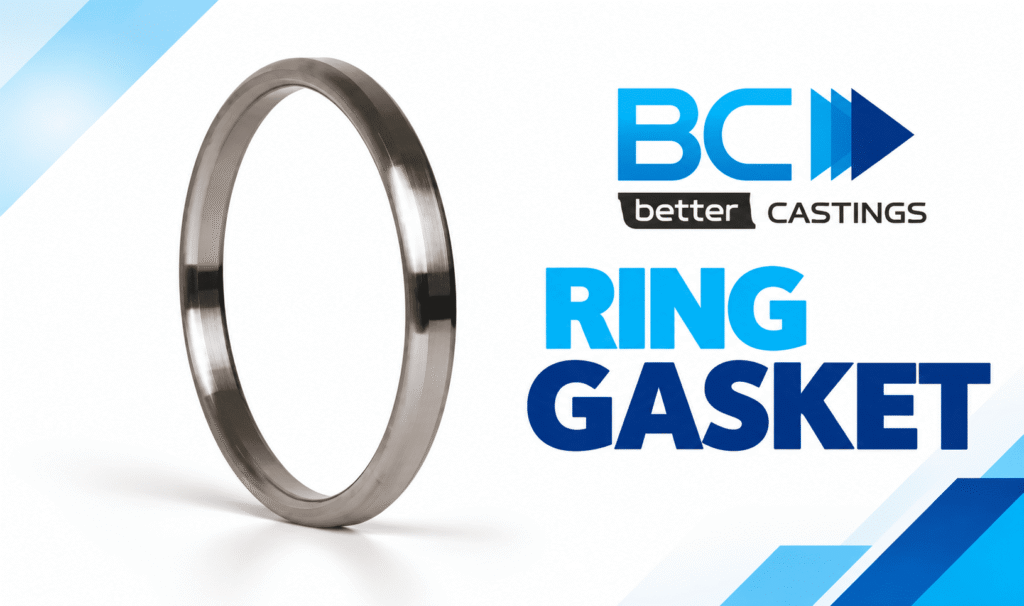
A ring gasket, also known as a Ring Type Joint (RTJ) gasket, is a precision-machined metal sealing ring used to create a reliable connection between mating flange faces. Unlike flat soft gaskets, it fits into a specially machined groove on the flange. When the flange bolts are tightened, the gasket is compressed into the groove to create a strong metal-to-metal seal. This design makes ring gaskets suitable for demanding applications involving high pressure, high temperature, and aggressive process fluids.
Ring gaskets are commonly used in oil and gas, petrochemical, refining, offshore, and high-pressure piping systems. They are manufactured as solid metal rings in profiles such as oval and octagonal, with dimensions matched to the applicable flange standard. Proper material selection, dimensional accuracy, flange condition, and installation are critical to sealing performance. Better Castings manufactures precision ring gaskets designed for demanding industrial applications, helping maintain reliable sealing performance under challenging operating conditions.
How Does a Ring Gasket Create a Reliable Seal?
A ring gasket seals through controlled metal deformation, not elasticity. The gasket material is manufactured softer than the flange itself, typically at least 30 Brinell hardness points lower, so when the bolts are torqued down, the ring cold-flows into the machined groove instead of the groove deforming around the ring.
This creates two tight metal-to-metal contact lines that block the pressure path completely. Unlike compressed fiber or rubber gaskets, there is no elastic recovery involved. Once the ring deforms, the seal is permanent for that installation, which is also why ring gaskets are never reused.
Cross-section shape affects how evenly this contact forms:
- Octagonal rings concentrate contact along two narrow lines, giving a tighter seal than the older oval profile.
- Oval rings still work but seal less precisely than octagonal profiles, especially on reused flanges.
- Pressure-energized RX rings use internal pressure to press harder against the groove walls as pressure rises, which is why they appear in the highest API 6A pressure classes.
Bolt torque sequence matters just as much as the ring itself. Uneven torqueing leaves gaps on one side before the opposite side seats fully, a common cause of incomplete seals at first startup.
What Are the Different Types of Ring Gaskets?
Ring gaskets come in three standard types, and the difference is the cross-section and how the ring behaves under pressure. Type R covers the original oval and octagonal profiles used across most ASME B16.20 flanges. Type RX is a pressure-energized variant built for API 6A flanges, where rising internal pressure presses the ring tighter into the groove instead of relying on bolt torque alone. Type BX is a heavier, higher-pressure design used specifically with API 6BX flanges on wellhead and Christmas tree equipment.
| Type | Cross-Section | Typical Flange Standard | Pressure Class Range | Reusable |
|---|---|---|---|---|
| Type R (Oval) | Oval | ASME B16.20 | Lower to mid pressure classes | No |
| Type R (Octagonal) | Octagonal | ASME B16.20, API 6A | Mid to high pressure classes | No |
| Type RX | Octagonal, pressure-energized | API 6A | High pressure classes | No |
| Type BX | Octagonal, heavy-duty | API 6BX | Highest pressure classes (wellhead / Christmas tree) | No |
What Materials Are Ring Gaskets Made Of?
Ring gaskets are most commonly made from soft iron, low carbon steel, or stainless steel, with higher alloys such as Monel and Inconel reserved for corrosive service. The choice always comes down to one rule: the gasket must be softer than the flange it seals against, so it deforms into the groove instead of damaging the flange face.
Corrosive or sour service changes the requirement. Grades 304 and 316 stainless resist general corrosion in wet or aggressive environments, while sour service, meaning H2S exposure, requires materials meeting NACE MR0175 limits. Monel 400 is a common choice, resisting both corrosion and sulfide stress cracking.
For the most demanding environments, higher alloys take over:
- Inconel 625 handles high chloride content and elevated temperatures where stainless steel would pit or crack.
- Titanium offers extreme corrosion resistance at a much higher cost, reserved for specialized subsea or chemical processing use.
- Duplex and super duplex alloys balance strength and corrosion resistance for mixed-service environments.
Material certification matters as much as alloy choice. Wrong hardness can gall the flange face or cause a failed seal, so mill-certificate traceability is standard on critical orders.
Where Are Ring Gaskets Commonly Used?
Ring gaskets are built for one job: sealing flanged connections that soft gaskets cannot handle. That makes oil and gas, petrochemical, and offshore industries their primary market, since these sectors regularly combine high pressure, high temperature, and corrosive media in the same connection.
Wellhead assemblies and Christmas trees rely on ring gaskets almost exclusively, since API 6A and API 6BX flange standards are built around the RTJ groove design. Subsea equipment adds another layer of demand, where a gasket failure is far more costly to access and repair than one on a surface installation.
Beyond upstream production, ring gaskets show up across several other high-demand settings:
- Refineries and petrochemical plants, on process piping carrying hydrocarbons at elevated pressure and temperature.
- Compressor stations, where cyclic pressure loading tests the seal repeatedly over the equipment’s life.
- High-pressure valve bonnets and manifolds, particularly on choke and kill lines.
- Power generation piping, where steam service demands a gasket that holds under sustained heat.
Any application where a leak carries safety, environmental, or downtime risk is a candidate for a ring gasket over a soft alternative. The higher upfront cost is minor next to an unplanned shutdown from a failed seal.
What Are the Key Benefits of Using Ring Gaskets?
Ring gaskets exist because soft gaskets reach a performance ceiling at extreme pressure and temperature. The metal-to-metal seal removes the elastic recovery and creep problems that limit compressed fiber and spiral-wound designs, which is the core advantage behind every other benefit.
Pressure and temperature capacity stand out first. Ring gaskets hold reliably at the pressure classes and temperatures where soft gaskets would extrude, blow out, or lose compression. That capacity comes with several practical advantages:
- No blowout risk, since the seal forms through deformation rather than compressed elasticity that can fail suddenly under pressure spikes.
- Corrosion resistance when matched to the right alloy, extending service life in sour or chemically aggressive environments.
- Dimensional consistency from precision machining, which keeps sealing performance predictable across every gasket from the same production run.
- Compliance with API and ASME flange standards, so gaskets integrate directly into existing equipment without custom modification.
The tradeoff is that ring gaskets cost more upfront than soft alternatives and require correct installation to perform. Neither downside outweighs the benefit in critical service, where a failed seal risks safety incidents, environmental exposure, or unplanned downtime that costs far more than the gasket itself.
How Do You Pick the Right Ring Gasket for Your Application?
Choosing the right ring gasket comes down to four factors: flange standard, pressure class, temperature range, and media compatibility. Start with the flange itself, since API 6A, API 6BX, and ASME B16.20 flanges each require a matching gasket type and cannot be mixed. From there, match the gasket’s pressure and temperature capability to the actual operating conditions, not just the flange rating. Media compatibility decides the material: sweet service allows soft iron or standard stainless, while sour or highly corrosive service pushes the selection toward NACE-compliant alloys.
| Factor | Consideration | Recommended Approach |
|---|---|---|
| Flange Standard | API 6A, API 6BX, or ASME B16.20 | Match the gasket type exactly to the flange standard; never mix standards. |
| Pressure Class | Operating pressure vs. flange rating | Select Type RX or BX for the highest pressure classes. |
| Temperature Range | Sustained operating temperature | Confirm the material’s rated temperature range, not just room-temperature hardness. |
| Media / Service | Sweet vs. sour vs. corrosive | Use NACE MR0175-compliant alloys, such as Monel or Inconel, for suitable sour-service applications. |
| Flange Condition | New vs. reused, groove wear | Inspect the groove condition before assuming standard sizing applies. |
How Do You Install and Inspect a Ring Gasket Properly?
Correct installation starts before the gasket ever touches the flange. Clean both grooves thoroughly, removing old gasket material, corrosion, and debris, then inspect the groove surfaces for pitting, scoring, or out-of-round wear that could prevent a full seal.
Verify the replacement ring matches the flange’s standard, pressure class, and required material before installation. Using the wrong ring, even one that physically fits, is one of the fastest ways to cause a failure under pressure.
A consistent installation and inspection sequence keeps results predictable:
- Center the ring in the groove and confirm it seats evenly before bringing the flanges together.
- Tighten bolts in a star or crisscross pattern, never in a single continuous pass around the flange.
- Torque in at least three progressive passes, reaching final torque value gradually rather than in one pass.
- Re-check torque after initial pressurization and after the first thermal cycle, since both can slightly loosen the joint.
Never reuse a ring gasket once it has been compressed, even if it looks undamaged. The deformation that created the seal the first time will not repeat accurately, and a reused ring is one of the most preventable causes of a repeat failure.
What Are the Common Causes of Ring Gasket Failure?
Most ring gasket failures trace back to installation error or material mismatch rather than a defect in the gasket itself. Identifying the actual cause matters, since replacing the gasket without correcting the root issue usually leads to a repeat failure.
Installation-related causes are the most frequent:
- Uneven or incorrect bolt torque, leaving part of the ring under-compressed while another section is fully seated.
- Reusing a previously compressed ring, which cannot recreate the original seal geometry.
- Skipping groove inspection, allowing corrosion or mechanical damage to prevent full contact.
Material and design mismatches cause the rest:
- Selecting a gasket harder than the flange, which prevents proper cold-flow and can damage the flange face instead of sealing it.
- Using a non-NACE-compliant material in sour service, leading to sulfide stress cracking over time.
- Galvanic corrosion from mismatched metals between the gasket and flange, which is often overlooked during material selection.
Thermal cycling and vibration also loosen bolted connections gradually, even when the original installation was correct. Routine re-torque checks after startup and after major temperature swings catch this before it becomes a leak, which is far cheaper than an unplanned shutdown.
Why Choose Better Castings as Your Ring Gasket Manufacturer?
Choosing a ring gasket manufacturer is a material sourcing decision as much as a purchasing one. The gasket’s performance depends on hardness control, dimensional accuracy, and material certification, so the manufacturer’s process matters as much as the drawing specification.
Better Castings manufactures ring gaskets to API and ASME dimensional tolerances, with material traceability carried through from mill certificate to finished part. That traceability matters most in sour or high-pressure service, where a mismatched or uncertified material is a common cause of failure long before installation even begins.
Working with a manufacturer rather than a generic distributor has practical advantages:
- Direct control over material sourcing and hardness verification, rather than relying on a third party’s documentation alone.
- Faster turnaround on non-standard sizes or materials, since production happens in-house rather than through a broker.
- A single point of accountability if a dimensional or material issue surfaces after delivery.
For sour service, offshore, or high-pressure wellhead applications, the margin for error is small enough that sourcing deserves the same scrutiny as the engineering specification. Better Castings works from that standard on every order, matching gasket type and material to the application before it ships.
About the Author
This is Tekumudi Girish, a Digital Marketing and SEO professional at Better Castings, specializing in technical content research and SEO-driven content development. His work focuses on translating complex industrial specifications into clear, accessible information for procurement and engineering audiences.
FAQ's
1. What Is a Ring Gasket Used For?
Ring gaskets are used to create reliable seals between flanges in high-pressure and high-temperature piping systems, especially in oil and gas applications.
2. Where Are Ring Gaskets Commonly Used?
They are commonly used in oil and gas, petrochemical plants, refineries, offshore equipment, wellheads, compressor stations, and high-pressure piping systems.
3. Why Are Ring Gaskets Preferred for High-Pressure Applications?
Ring gaskets create a metal-to-metal seal through controlled deformation, allowing them to withstand demanding pressure and temperature conditions.
4. What Is the Difference Between Type R, RX, and BX Ring Gaskets?
Type R uses standard oval or octagonal profiles, while RX is pressure-energized and BX is designed for the highest-pressure API 6BX applications.
5. How Do You Choose the Right Ring Gasket?
Select the gasket based on the flange standard, pressure class, operating temperature, service media, material compatibility, and flange condition.
6. What Materials Are Used for Ring Gaskets?
Common materials include soft iron, low-carbon steel, stainless steel, Monel, Inconel, duplex alloys, and other materials selected according to service conditions.
7. Can Ring Gaskets Be Reused After Installation?
No. Ring gaskets are not designed for reuse because they deform during installation and cannot reliably recreate the original sealing geometry.
8. How Do You Prevent Ring Gasket Failure?
Proper flange-groove inspection, correct gasket selection, accurate alignment, and controlled bolt tightening help prevent common ring gasket sealing failures.

Very informative article. The explanation of ring gasket types was really helpful.
[560046]supplies professional anti-violence equipments and solutions for the whole world with strong and perfect production capacity. anti-violence.org
nice information about ring gasket