
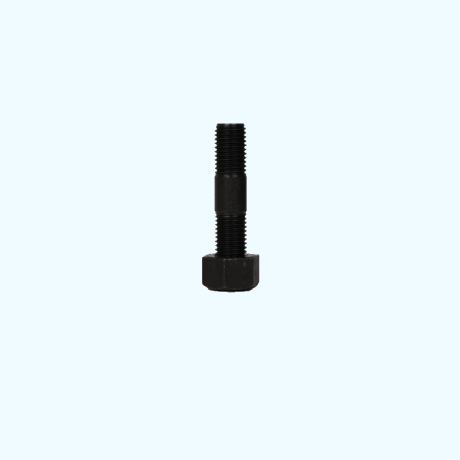
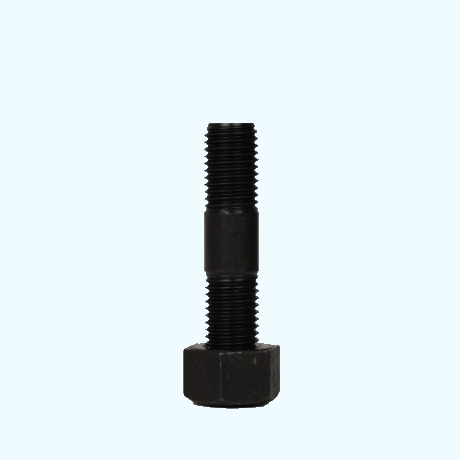
B7 Tap End Studs
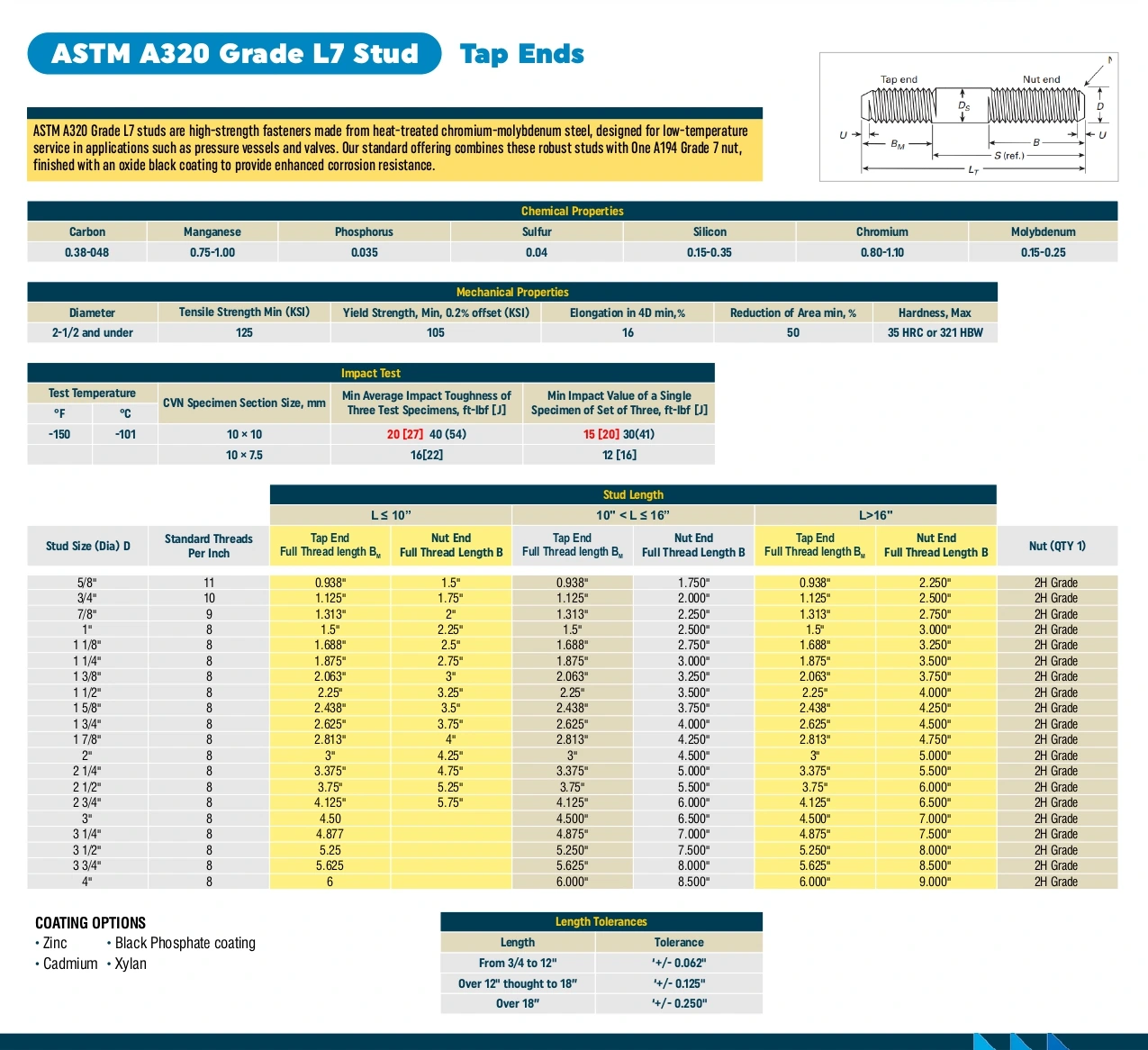
| SL. NO. | COATING OPTIONS |
|---|---|
| 1 | Zinc |
| 2 | Black Phosphate coating |
| 3 | Cadmium |
| 4 | Xylan |
B7 Tap End Studs are high-strength threaded fasteners designed for secure flange connections in demanding pressure and temperature applications. Manufactured from heat-treated alloy steel, these studs are widely specified by industrial buyers, procurement engineers, EPC contractors, maintenance teams, and project managers for critical piping and pressure equipment. Their threaded tap end allows direct engagement into tapped holes, eliminating the need for nuts on one end while ensuring a rigid and reliable connection. Suitable for refineries, petrochemical plants, offshore facilities, power generation, and process industries, B7 Tap End Studs deliver dependable mechanical performance and comply with internationally recognized manufacturing and material standards.
RFQ Forms-Studs
Details for quotation.
B7 tap‑end studs are produced to ASTM A193 Grade B7 with controlled quench‑and‑temper heat treatment and are normally used with heavy hex nuts per ASTM A194 Grade 2H. One end is threaded to engage a tapped flange or equipment body while the opposite end accepts a nut; thread geometry and tolerances follow ASME B1.1 (inch) or ASME B1.13M (metric) as applicable. Nut dimensions and heavy‑hex requirements reference standards such as ASME B18.31.2 where relevant, and manufacturing and inspection should align with project quality systems like ISO 9001.
Tap‑end studs simplify assembly where through‑bolting is impractical while maintaining high clamping force and joint integrity for high‑pressure and elevated‑temperature services. Specify tap‑end studs per the governing piping, flange, or equipment code (for example ASME B16.5, ASME B31.3, and applicable API standards) and ensure material selection considers corrosion, H₂S/sour‑service requirements, and operating temperature limits when choosing B7.
- Manufactured from ASTM A193 Grade B7 alloy steel
- High tensile strength for demanding pressure applications
- Tap end design for threaded equipment connections
- Suitable for elevated temperature service
- Excellent fatigue and vibration resistance
- Precision-machined threads for secure installation
- Compatible with standard industrial flange assemblies
- Available in metric and imperial thread standards
- Heat-treated for improved mechanical performance
- Produced according to international quality standards
Surface Finish Options
Material selection depends on operating pressure, temperature, environmental exposure, and project specifications.
ASTM A193 Grade B7
The industry-standard chromium-molybdenum alloy steel offering high tensile strength, excellent toughness, and reliable performance in pressure-containing equipment.
ASTM A193 Grade B16
Suitable for higher operating temperatures where improved creep resistance is required.
ASTM A320 Grades
Available for low-temperature applications requiring enhanced toughness and impact resistance.
Stainless Steel Grades
304, 316, and other stainless steel grades are available for corrosive environments where oxidation resistance is a priority.
Specialty Alloy Materials
Duplex Stainless Steel, Super Duplex, Inconel, Monel, and other engineered alloys can be supplied for demanding offshore and chemical processing applications.
Other alloy materials can be manufactured to meet specific project specifications and international standards.
Applications
Wellhead Equipment Assembly
Used for securing critical pressure‑containing components; B7 may be suitable in non‑sour, non‑corrosive wellhead services but material selection must follow API/NACE and project requirements.
Heat Exchanger Channel Covers
Provides reliable fastening for removable covers subjected to thermal expansion and process pressure; B7 is commonly used where corrosion is not severe.
High-Energy Steam Systems
Specified for bolted joints operating under elevated temperatures and continuous mechanical stress; B7 is frequently selected when temperature and strength requirements are met.
Compressor Casing Connections
Supports secure fastening in rotating equipment where vibration resistance is important; B7 can be used where corrosion is manageable and proper preload practice is applied.
Reactor Vessel Closures
Used in chemical and process facilities requiring dependable bolt preload retention; B7 may be acceptable in non‑corrosive services but corrosion‑resistant alloys are required for aggressive chemistries or sour service.
Pipeline Isolation Valves
Ensures secure attachment of valve bodies and bonnets; B7 is used in non‑corrosive pipeline environments but NACE‑qualified or corrosion‑resistant bolting is required for seawater, chloride, or H₂S exposure.
Offshore Production Modules
Suitable for structural and equipment bolting in protected or internal applications; plain B7 is generally not the default for exposed marine service where corrosion‑resistant alloys or qualified coatings are commonly required.
Industrial Furnace Equipment
Applied in equipment exposed to recurring thermal cycles and demanding operating conditions; B7 may be used where operating temperatures and oxidation/creep demands are within its limits.
Frequently asked questions
B7 Tap End Studs are high-strength alloy steel fasteners with one threaded end designed to engage directly into tapped holes while the opposite end is secured with a nut.
They are commonly manufactured from ASTM A193 Grade B7 heat-treated chromium-molybdenum alloy steel for high-pressure service.
They are widely used in oil and gas facilities, refineries, petrochemical plants, power stations, pressure vessels, valves, and high-pressure piping systems.
Manufacturing generally complies with ASTM A193, ASTM A194, ASME B18.31.2, ASME PCC-1, applicable API specifications, and ISO 9001 quality management standards.
Yes. ASTM A193 Grade B7 provides excellent mechanical properties for elevated temperature service in pressure-containing equipment.
Yes. Better Castings can manufacture custom dimensions, thread configurations, coatings, and finishes to meet project specifications.
