
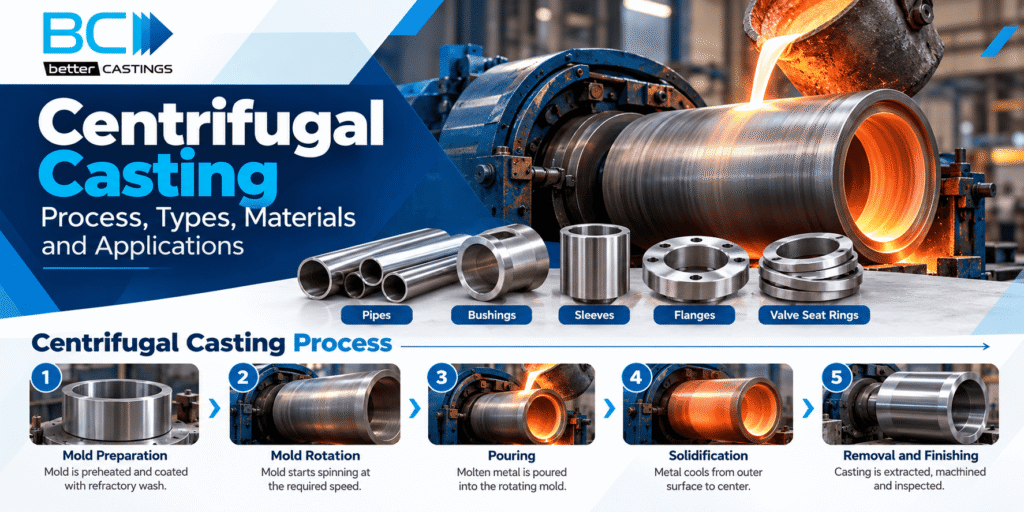
Centrifugal casting is a metal casting method in which molten metal is poured into a rotating mold. The spinning action forces the metal against the mold wall, where it solidifies into a dense, uniform part.
Manufacturers use it to produce cylindrical and ring-shaped components such as pipes, bushings, sleeves, flanges and valve seat rings. It is one of the most dependable ways to make round parts that must handle pressure, wear and heat.
What Is Centrifugal Casting?
Centrifugal casting uses rotational force, rather than gravity alone, to fill the mold and feed the casting as it solidifies. The method was first patented in England in 1809 and became a mainstream industrial process in the early 20th century, when foundries adopted it for cast iron pipe.
The principle is simple. As the mold spins, the molten metal experiences a force many times stronger than gravity. Denser metal is pushed outward to the mold wall, while lighter impurities such as oxides, slag and trapped gas move toward the inner bore.
That inner layer is machined away after casting. What remains is a clean, fine-grained metal wall with very low porosity.
How Does the Centrifugal Casting Process Work?
The centrifugal casting process follows five main stages.
Mold Preparation
Most centrifugal molds are made from steel or cast iron. The mold is preheated and coated with a refractory wash, which protects the mold, controls the cooling rate and helps release the casting.
Mold Rotation
The mold starts spinning before any metal is poured. Rotational speed depends on the mold diameter and the alloy, and usually ranges from a few hundred to a few thousand revolutions per minute.
The aim is enough force to hold the metal firmly against the wall. Too little speed lets the metal slide or fall, while too much can cause cracking.
Pouring
Molten metal enters the spinning mold through a pouring spout or basin. The volume of metal poured sets the wall thickness of the finished part, so hollow shapes need no inner core.
Solidification
The metal cools from the outer surface toward the center. This directional solidification lets the still-liquid metal near the bore feed the solidifying layers, which limits shrinkage defects.
Removal and Finishing
Once solid, the casting is extracted from the mold. It then goes through machining of the inner and outer diameters, heat treatment where required, and inspection.
Types of Centrifugal Casting
There are three main types, each suited to a different part shape.
True Centrifugal Casting
In true centrifugal casting, the mold spins around the axis of the part itself and no core is used. Centrifugal force alone forms the inner diameter, producing hollow cylinders with consistent wall thickness.
Horizontal and Vertical Centrifugal Casting
True centrifugal casting runs on either a horizontal or a vertical axis.
Horizontal centrifugal casting suits parts that are longer than their diameter, such as pipes, tubes and long sleeves. The horizontal axis keeps the wall thickness even along the full length.
Vertical centrifugal casting suits short, large-diameter parts such as rings, flanges, valve seats and bushings. Gravity gives the inner bore a slight taper, which is removed during machining.
Semi-Centrifugal Casting
Semi-centrifugal casting produces solid, rotationally symmetric parts. The mold spins on a vertical axis while a central riser feeds the casting. Typical parts include wheels, pulleys, gear blanks and discs.
The outer section receives the highest density. The lower-quality center is usually machined out.
Centrifuge Casting
In centrifuge casting, several mold cavities sit around a central sprue, and the whole assembly spins. Rotational force drives metal into each cavity. This method suits small, detailed parts that are not symmetrical, such as jewelry, dental components and small fittings.
Materials Used in Centrifugal Casting
Most castable alloys work with this process:
- Cast irons: gray and ductile iron, widely used for pipes and cylinder liners
- Carbon and low-alloy steels: for structural rings, rolls and pressure parts
- Stainless steels: austenitic and duplex grades for corrosive service
- Nickel-based alloys: for high-temperature and highly corrosive environments
- Copper alloys: bronzes, aluminum bronze and brass for bushings, bearings and valve parts
- Aluminum alloys: for lightweight cylindrical parts
The process also supports bimetallic castings. A second alloy is poured after the first layer partly solidifies, giving a part with, for example, a wear-resistant inner layer and a tough outer shell.
Common Centrifugal Casting Products
- Pipes and tubes
- Cylinder liners
- Bushings and bearings
- Sleeves and shaft liners
- Valve seat rings and other round valve components
- Flanges and rings
- Mill rolls
- Gear blanks and wheels
Industrial Applications of Centrifugal Casting
Centrifugal casting applications span every industry that needs strong, leak-tight round parts:
- Oil and gas: pipes, valve components and pump parts
- Petrochemical: furnace tubes and high-temperature piping
- Power generation: turbine rings, sleeves and condenser parts
- Water and wastewater: ductile iron pipes and fittings
- Marine: propeller shaft sleeves and bronze bearings
- Automotive: cylinder liners and brake drums
- Steel and paper mills: rolls and roll shells
- Aerospace: engine rings and seal components
Benefits of Centrifugal Casting
High density. Centrifugal force produces a compact, fine-grained structure with very little porosity in the outer wall.
Clean metal. Impurities collect at the inner bore, where machining removes them.
Strong mechanical properties. Dense, uniform metal gives better strength and fatigue resistance than many static castings of the same alloy.
No cores for hollow parts. True centrifugal casting forms the bore without a core, which saves cost and removes a common source of defects.
High material yield. True centrifugal castings need few or no gates and risers, so less metal is wasted.
Wide size range. The process handles parts from a few inches to several meters in diameter or length.
Limitations of Centrifugal Casting
Limited shapes. True and semi-centrifugal casting only produce rotationally symmetric parts.
Machining is required. The inner layer holds impurities and must be machined, which adds time and cost.
High equipment cost. Casting machines and permanent molds require significant investment.
Alloy segregation. Heavier elements in some alloys can separate under rotational force. Leaded bronzes, for example, need careful process control.
Process sensitivity. Speed, pouring temperature and cooling rate must stay within tight limits to avoid defects.
Common Centrifugal Casting Defects and Quality Control
Typical Defects
Most centrifugal casting defects trace back to incorrect speed, temperature or cooling:
- Raining: metal drops from the top of a horizontal mold when rotation is too slow
- Longitudinal cracks and hot tears: caused by excessive speed or uneven cooling
- Cold laps: layers that fail to fuse because the metal was poured too cold
- Segregation bands: alloying elements separating into rings within the wall
- Porosity and inclusions: usually concentrated near the bore
- Vibration defects: caused by an unbalanced or misaligned mold
Quality Control Methods
Foundries verify castings through a combination of tests:
- Chemical analysis by spectrometer
- Dimensional inspection
- Ultrasonic and radiographic testing for internal defects
- Dye penetrant and magnetic particle testing for surface cracks
- Tensile, hardness and impact testing
- Hydrostatic testing for pressure-containing parts
Several ASTM standards cover centrifugally cast products, including ASTM A426 for ferritic alloy steel pipe, ASTM A451 for austenitic steel pipe and ASTM B271 for copper-base alloy castings.
Centrifugal Casting vs Other Casting Methods
| Factor | Centrifugal Casting | Sand Casting | Investment Casting | Die Casting |
|---|---|---|---|---|
| Typical Part Shapes | Cylinders, tubes, rings, and sleeves | Simple to complex shapes, including large components | Complex shapes with fine details | Complex shapes, including thin-walled components |
| Density and Porosity | Can produce dense castings with low porosity under suitable conditions | Porosity and inclusions depend on mould design and process control | Can produce sound, detailed castings with appropriate process control | Gas porosity may occur during high-pressure metal injection |
| Common Alloys | Cast iron, steel, stainless steel, nickel-based, and copper-based alloys | Cast iron, steel, aluminium, copper-based, and other suitable alloys | Stainless steel, carbon steel, nickel-based, and other castable alloys | Mainly aluminium, zinc, and magnesium alloys |
| Relative Tooling Cost | Varies with equipment and mould design | Generally low | Moderate; precision pattern tooling is required | Generally high due to durable metal dies |
| Best Suited For | Rotationally symmetrical parts requiring good structural integrity | Large components, varied geometries, and low-to-medium production volumes | Complex precision components with good surface finish | High-volume production of suitable non-ferrous alloy components |
How to Choose a Centrifugal Casting Manufacturer
Check these points before placing an order:
- Alloy range: confirm the foundry regularly casts your required grade
- Size capability: check the maximum diameter, length and weight it can produce
- Process type: make sure it offers horizontal, vertical or semi-centrifugal casting as your part requires
- Machining: in-house machining shortens lead times and keeps accountability with one supplier
- Testing: look for in-house NDT, mechanical testing and chemical analysis
- Certifications: ask for ISO 9001 certification and material test certificates with every shipment
- Industry experience: a supplier familiar with your sector understands its standards and service conditions
FAQ's
What is centrifugal casting?
Centrifugal casting uses rotational force to distribute molten metal inside a rotating mold. It produces dense metal components with good structural integrity.
What products are made using centrifugal casting?
Common products include pipes, tubes, bushings, sleeves, flanges, and cylinder liners. Suitable valve seat rings can also be manufactured using this process.
What materials are used in centrifugal casting?
Common materials include cast iron, carbon steel, stainless steel, nickel-based alloys, and copper alloys. Material selection depends on the component’s application and operating conditions.
What are the main advantages of centrifugal casting?
Centrifugal casting can produce dense components with low porosity and good mechanical properties. It also reduces the need for cores when manufacturing hollow cylindrical parts.
What are the different types of centrifugal casting?
The main types are true centrifugal casting, semi-centrifugal casting, and centrifuge casting. Each method is suitable for different component shapes and manufacturing requirements.
Which industries use centrifugal casting?
Industries include oil and gas, petrochemicals, automotive, marine, and power generation. These industries use centrifugally cast components for demanding operating conditions.
What is the difference between centrifugal casting and sand casting?
Centrifugal casting is ideal for cylindrical and ring-shaped components requiring high density. Sand casting is more versatile for complex shapes and irregular parts.
How do you choose a centrifugal casting manufacturer?
Evaluate the manufacturer’s material capabilities, production capacity, machining facilities, and quality-control procedures. Check relevant certifications and experience with your required components.
About the Author
I’m Girish, an SEO content writer at Better Castings, specializing in SEO, Answer Engine Optimization (AEO), and Generative Engine Optimization (GEO). I create informative, search-friendly content about metal casting processes, industrial materials, and manufacturing technologies, focusing on delivering accurate, valuable information that helps readers understand technical topics and find relevant answers across search engines and AI-powered platforms.
