
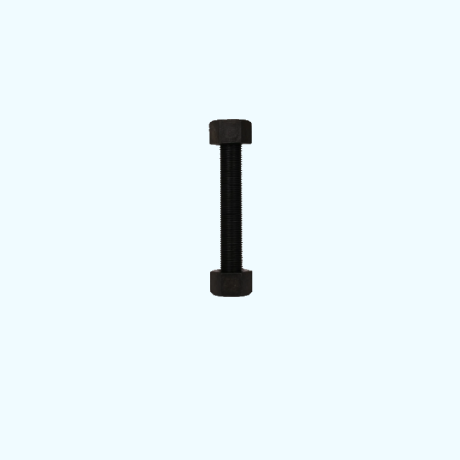
L7 All Thread Studs
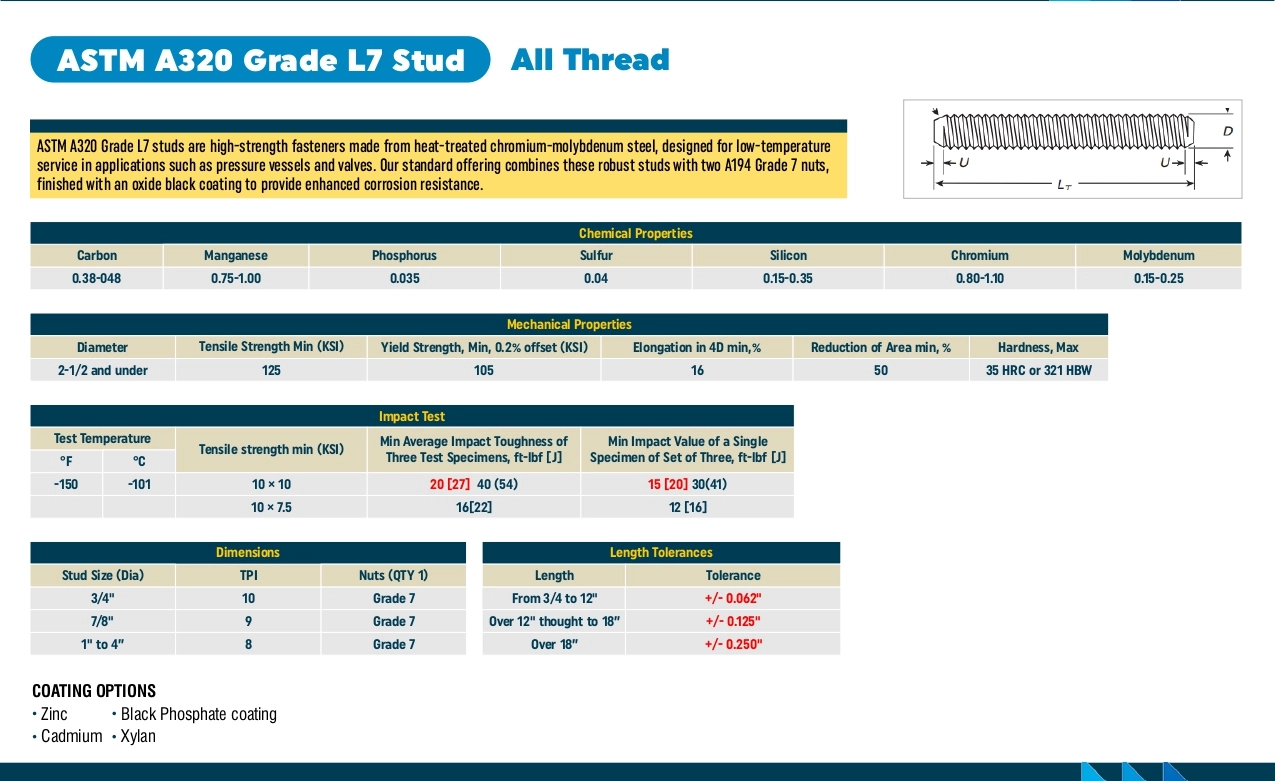
| SL. NO. | COATING OPTIONS |
|---|---|
| 1 | Zinc |
| 2 | Black Phosphate coating |
| 3 | Cadmium |
| 4 | Xylan |
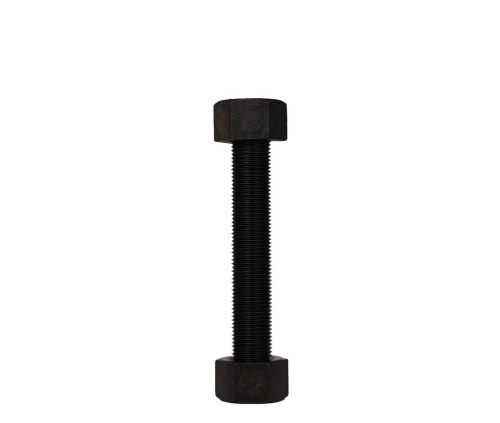
L7 All Thread Studs are specialized alloy steel fasteners developed for bolted connections operating in sub-zero and cryogenic environments. Designed to maintain mechanical strength and toughness at extremely low temperatures, these studs are widely specified for equipment where conventional fasteners may become brittle or lose performance.
Industrial buyers, EPC contractors, maintenance teams, and project engineers rely on ASTM A320 L7 studs for applications involving liquefied gases, refrigeration systems, offshore facilities, and low-temperature processing equipment. Their fully threaded configuration provides installation flexibility while ensuring reliable load transfer across critical joints. Manufactured under strict quality controls and recognized international standards, L7 All Thread Studs deliver dependable fastening performance in some of the most challenging operating environments found across global industries.
RFQ Forms-Studs
Details for quotation.
L7 all‑thread studs are manufactured to the metallurgical and mechanical requirements of ASTM A193 Grade L7 and are quenched and tempered to achieve the specified strength, toughness, and low‑temperature impact properties. They are typically paired with heavy hex nuts per ASTM A194 Grade 7, which are required for low‑temperature bolting applications. Threads and tolerances are produced to the applicable thread standards — ASME B1.1 for Unified inch threads or ASME B1.13M for metric threads — and heat‑treatment, hardness, Charpy impact testing, and traceability should meet project quality systems such as ISO 9001 where required.
Continuous threading along the stud length provides installation flexibility, simplifies alignment, and improves load distribution across the joint, making L7 all‑thread studs well suited for flange and pressure‑retaining connections in low‑temperature service. In service, select stud grade, nut grade, thread form, and preload practice in accordance with the governing codes and project specifications (for example ASME B16.5, ASME B31.3, and applicable API standards) and account for corrosion, sour‑service, and minimum design metal temperature (MDMT) limits when specifying L7.
- Manufactured to ASTM A320 Grade L7 requirements
- Engineered for low-temperature and cryogenic service
- Maintains toughness in sub-zero operating conditions
- Fully threaded design for versatile installation
- Suitable for pressure-containing equipment
- Reliable preload retention during thermal contraction
- Compatible with industrial flange systems
- Available in custom lengths and diameters
- Heat-treated for enhanced mechanical properties
- Offered with multiple protective surface finishes
Surface Finish Options
Material selection depends on operating pressure, process media, temperature, corrosion resistance, and flange material compatibility.
ASTM A320 Grade L7 Alloy Steel
The standard material used for low-temperature bolting applications where impact toughness and strength retention are critical.
PTFE-Coated L7 Studs
Recommended for environments requiring enhanced corrosion resistance and improved installation characteristics.
Zinc-Flake Coated Fasteners
Provide additional protection against atmospheric corrosion while maintaining dimensional accuracy.
Cadmium-Free Protective Coatings
Suitable for industrial applications where environmental compliance and corrosion protection are priorities.
Fluoropolymer Surface Treatments
Used in process environments where exposure to moisture, chemicals, or corrosive atmospheres is expected.
Project-Specific Finishes
Custom coating systems can be supplied to match client specifications and operating conditions.
Other alloy materials can be manufactured to meet specific project specifications and international standards.
Applications
Wellhead Equipment Assembly
Used for securing critical pressure‑containing components; L7 may be suitable in non‑sour, non‑corrosive wellhead services but selection must comply with API/NACE and project specifications.
Heat Exchanger Channel Covers
Provides reliable fastening for removable covers subjected to thermal expansion and process pressure; L7 is commonly used where strength and temperature capability are required and corrosion is limited.
High‑Energy Steam Systems
Specified for bolted joints operating under elevated temperatures and continuous mechanical stress; L7 is often selected for high‑strength, elevated‑temperature steam applications when service conditions permit.
Compressor Casing Connections
Supports secure fastening in rotating equipment where vibration resistance is important; L7 can be used where corrosion is manageable and correct preload and nut pairing are applied.
Reactor Vessel Closures
Used in chemical and process facilities requiring dependable bolt preload retention; L7 may be acceptable in non‑corrosive reactor services but corrosion‑resistant alloys are required for aggressive chemistries or sour service.
Pipeline Isolation Valves
Ensures secure attachment of valve bodies and bonnets; L7 is used in non‑corrosive pipeline environments but NACE‑qualified or corrosion‑resistant bolting is required for seawater, chloride, or H₂S exposure.
Offshore Production Modules
Suitable for structural and equipment bolting in protected or internal applications; plain L7 is generally not the default for exposed marine service where corrosion‑resistant alloys or qualified coatings are commonly required.
Industrial Furnace Equipment
Applied in equipment exposed to recurring thermal cycles and demanding operating conditions; L7 may be used where operating temperatures and oxidation/creep demands are within its material limits.
Frequently asked questions
L7 All Thread Studs are alloy steel fasteners manufactured to ASTM A320 Grade L7 standards for low-temperature and cryogenic applications.
L7 studs are specifically engineered to maintain toughness and impact resistance at low temperatures, making them suitable for cryogenic service.
They are widely used in LNG facilities, gas processing plants, refrigeration systems, air separation units, and cryogenic storage applications.
Yes. They are frequently specified for flanges, valves, pressure vessels, and related equipment operating at low temperatures.
Production generally follows ASTM A320 requirements along with relevant ASME, API, and ISO standards.
Yes. L7 All Thread Studs can be manufactured in a variety of diameters, lengths, and thread configurations to meet project specifications.
