
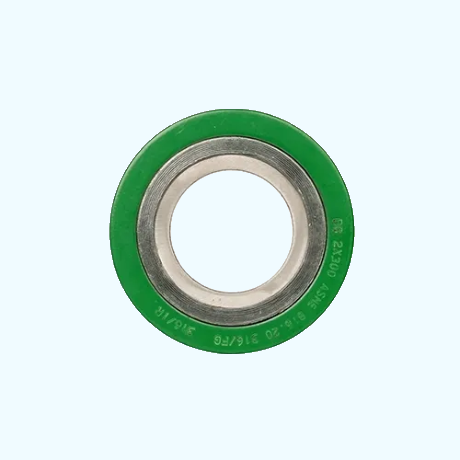
R (Gasket only)
R Spiral Wound Gasket is a precision-engineered sealing solution designed for bolted flange connections operating under challenging pressure and temperature conditions. Widely specified by procurement engineers, EPC contractors, plant maintenance teams, and industrial project managers, this gasket delivers dependable sealing performance across critical process systems.
Its semi-metallic construction combines metallic strength with compressible filler materials, allowing the gasket to maintain sealing integrity despite thermal expansion, pressure cycling, and flange movement. Suitable for global industrial applications, R Spiral Wound Gaskets are commonly installed in refineries, offshore facilities, power plants, chemical processing units, and pipeline infrastructure. Manufactured in accordance with recognized standards such as ASME, API, ASTM, and ISO requirements, these gaskets support safe operation and reduced maintenance in demanding service environments.
Gaskets Enquiry Form
The R Spiral Wound Gasket consists of a continuously wound metal strip combined with a soft sealing filler. During manufacturing, the metal winding and filler material are spirally wrapped together to create alternating layers that provide both resilience and sealing efficiency.
When compressed between mating flange faces, the metallic winding supplies structural strength while the filler material conforms to surface irregularities. This dual-action sealing mechanism helps maintain gasket stress throughout service life, even when exposed to vibration, thermal fluctuations, and operating pressure changes.
Depending on application requirements, the gasket may be supplied with inner rings, outer guide rings, or both. These components improve centering, compression control, and blowout resistance. R Spiral Wound Gaskets are commonly selected for raised face flanges and process systems where reliability and long-term sealing performance are critical.
Production and dimensional requirements typically align with ASME B16.20, ASME B16.5, API specifications, ASTM material standards, and ISO quality management practices.
- Semi-metallic construction for strength and flexibility
- Suitable for elevated pressure and temperature service
- Maintains sealing performance during thermal cycling
- Resistant to flange movement and vibration
- Available with inner and outer guide rings
- Compatible with a wide range of process media
- Precision manufactured to international standards
- Effective for critical flange sealing applications
- Available in standard and custom dimensions
- Designed for long operational service life
Material Options
Material selection depends on operating pressure, process media, temperature, corrosion resistance, and flange material compatibility.
Stainless Steel with Graphite Filler
A widely used combination for high-temperature process systems. The stainless steel winding provides mechanical strength while graphite offers excellent thermal stability.
Stainless Steel with PTFE Filler
Suitable for chemical processing applications where resistance to aggressive media is essential. PTFE provides broad chemical compatibility and low contamination risk.
316 Stainless Steel
Preferred for corrosive environments due to enhanced resistance to chlorides and chemical exposure.
321 Stainless Steel
Selected for elevated temperature applications where improved oxidation resistance is required.
Monel
Used in marine and saltwater environments where corrosion resistance is a primary concern.
Inconel
Chosen for severe service conditions involving high temperatures, oxidation, and demanding process environments.
Other alloy materials can be manufactured to meet specific project specifications and international standards.
Applications
Refinery Process Units
Used in flange joints handling hydrocarbons, steam, and process fluids under continuous operating conditions.
LNG and Gas Processing Facilities
Provides dependable sealing performance in equipment subjected to pressure variation and temperature changes.
Thermal Power Plants
Installed in steam distribution systems, heat recovery equipment, and auxiliary process piping.
Offshore Production Platforms
Supports leak prevention in compact process systems exposed to vibration and marine environments.
Chemical Manufacturing Plants
Suitable for process lines carrying corrosive fluids, solvents, and specialty chemicals.
Industrial Pipeline Networks
Used in transmission and distribution systems where reliable flange sealing is essential for operational safety.
Pressure Vessel Connections
Applied in bolted joints requiring controlled gasket compression and long-term sealing performance.
Frequently asked questions
An R Spiral Wound Gasket is a semi-metallic gasket made from a spirally wound metal strip and filler material designed for high-performance flange sealing.
Yes. Their reinforced construction makes them suitable for demanding high-pressure and high-temperature operating conditions.
Yes. Spiral wound gaskets can be manufactured in custom dimensions to match specific flange and equipment requirements.
A semi-metallic gasket combines metal reinforcement with a compressible filler, offering greater strength and performance in severe operating conditions.
Most spiral wound gaskets are produced according to ASME B16.20, ASME B16.5, API requirements, ASTM material standards, and ISO quality systems.
Flexible graphite is commonly selected because it provides excellent thermal resistance and sealing reliability.
They are primarily used with raised face flanges but can also be designed for other flange configurations depending on application needs.
Yes. Material combinations such as stainless steel and PTFE provide excellent compatibility with many chemical process applications.
